
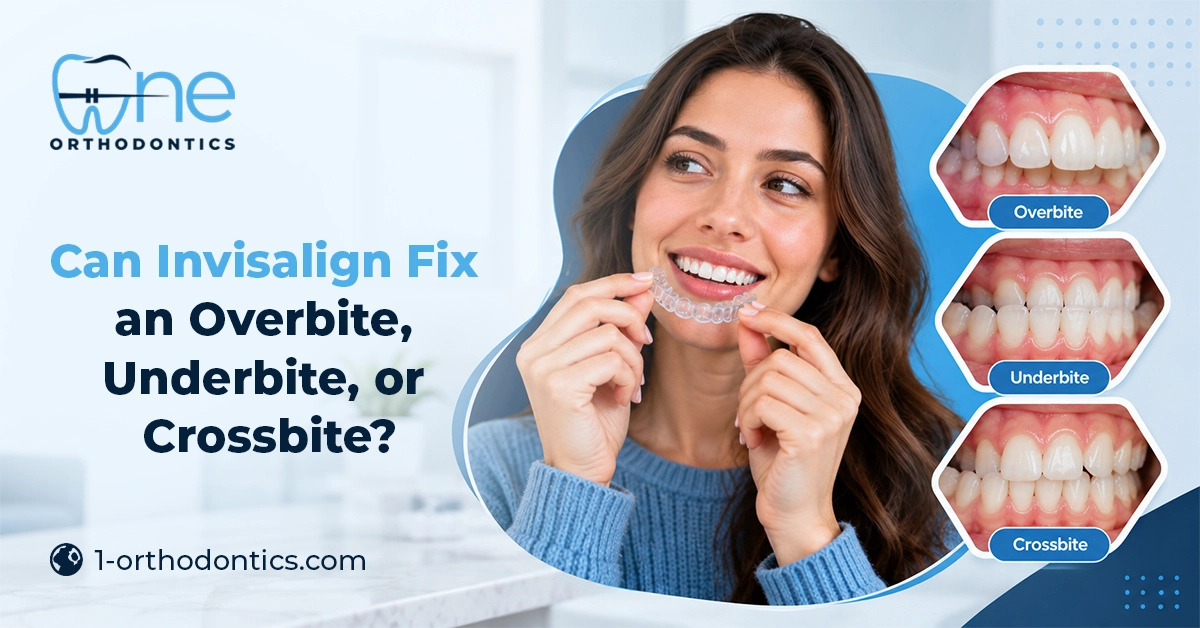
Can Invisalign fix an overbite, underbite, and crossbite? It works best when these issues aren't too severe. In some cases, it can work with other devices to fix complex malocclusions. There is just one way to be sure about that – go to an orthodontist. Malpositioned teeth are usually in the limelight when talking about braces.
But bite issues are also a major reason for seeking treatment. Maybe your top teeth overlap too much with your bottom teeth. Maybe your jaw protrudes from your face. Or maybe some of your teeth sit inside the others when you bite down.
These are all issues with your bite, and these issues can have a negative impact on your smile and the way that you feel about it. The good news? You do not have to get braces to correct bite issues. Invisalign has been able to treat many cases that once would have required the use of braces.
In the next sections, we’ll cover the bite issues Invisalign can fix. We’ll also compare Invisalign to braces and identify the best candidates for Invisalign treatment.
An overbite occurs when your front upper teeth overlap your front teeth too much. A small overlap is normal and healthy an excessive overbite is not. If left untreated, a deep overbite can cause tooth wear, jaw strain, and trouble chewing. Read our full guide, What Is an Overbite? Signs, Causes & Treatment Options, for the complete rundown.
Underbite refers to having lower teeth in front of your upper teeth when the mouth is closed. This condition is the exact opposite of an overbite. The condition develops because of how the jawbone has developed or the positioning of teeth. This causes difficulties when biting, chewing, and speaking.
Crossbite is the condition where some of the teeth of the upper jaw overlap inside some teeth of the lower jaw while biting. This may occur at either the front or the sides of the jaws. Neglecting crossbite can cause wear of enamel, receding gums, and uneven jaw development.
Yes Invisalign can fix an overbite case. It's one of the most common orthodontic issues handled with clear aligners.
Invisalign treatment uses custom aligners to shift your teeth into place. For overbites, the orthodontist may use tooth-colored attachments or elastics. These help guide the jaw and level the bite.
Overbites caused by misalignment of the teeth are perfect candidates for Invisalign treatment.
Sometimes but underbites are a bit trickier. Invisalign for underbite works well for dental issues where the teeth are misaligned. It’s less effective for skeletal problems, like a misaligned jawbone.
For mild underbites, aligners can shift the lower teeth back. They also move the upper teeth forward. This helps create a healthier bite. Severe underbites from jaw growth may need treatment. This can include braces, elastics, or jaw surgery.
The honest answer here: an orthodontist needs to look at your specific case. Underbites vary a lot from person to person.
Yes, Invisalign for crossbite treatment is often effective. It works especially well for front tooth and single tooth crossbites.
Crossbites occur when the teeth are not aligned horizontally. Untreated crossbites can cause enamel wear, gum problems, and uneven jaw growth. The Invisalign treatment helps move these misaligned teeth into proper alignment.
Both work they just fit different lifestyles and cases. The table below breaks down the key differences so you can see where each option shines.
| Factor | Invisalign | Traditional Braces |
| Appearance | Clear and nearly invisible | Visible metal or ceramic |
| Comfort | No sharp brackets or wires | Brackets can irritate cheeks |
| Convenience | Removable for eating and brushing | Fixed in place |
| Complex cases | Best for mild to moderate issues | Better for severe skeletal problems |
| Discipline required | Must wear 20–22 hours a day | Works without daily effort |
Table: A side-by-side comparison of Invisalign and traditional braces for bite correction.
For many adults and teens with mild to moderate bite issues, Invisalign offers a discreet, comfortable path to a better bite. For serious structural problems, braces may still be the smarter choice.
The only way to know for sure is a proper evaluation. At One Orthodontics with Invisalign in Fredericksburg, VA an exam and digital scan will show exactly what your bite needs and whether Invisalign can get you there.
You might be a good candidate for Invisalign in Fredericksburg, VA if:
There are some common characteristics among great candidates for Invisalign that include:
One Orthodontics in Fredericksburg, VA, will assess your smile with an exam and a digital scan.
Reach Out to One Orthodontics About Invisalign for Overbite. Find out if clear aligners can improve your bite, comfort, and confidence with a personalized consultation.
Q: How long does Invisalign take to fix a bite problem?
Most bite corrections take 12 to 18 months, though mild cases can finish sooner and complex ones take longer. Your orthodontist will give you a timeline after your evaluation.
Q: Is Invisalign more painful than braces?
No. Most patients find Invisalign more comfortable since there are no brackets or wires. You may feel mild pressure for a day or two after switching to a new set of aligners.
Q: Can Invisalign fix a severe overbite or underbite?
Not always on its own. Severe skeletal cases may need braces, elastics, or jaw surgery. An orthodontist can tell you if Invisalign alone is enough.
Q: Does insurance cover Invisalign for bite correction?
Many dental plans cover Invisalign the same way they cover braces. Check your orthodontic benefits, and ask the office about payment plans.
Q: Can teens use Invisalign for bite problems?
Yes. Invisalign Teen is designed for younger patients and works well for many mild to moderate bite issues, as long as the teen wears the aligners consistently.
The doctor consistently offered attentive and comprehensive orthodontic care, carefully examining every aspect. The entire team, including the reception staff,... read more

 DANNY J.
The best experience ever! The staff is amazing and welcoming. They accepted my challenging teeth. I highly recommend them. The... read more
 Juan L.
I just wanted to say thank you to Dr. Mo and the entire team for such a great experience! From... read more
 Hamza S.
had a really good experience with their free consultations and can't wait to start their treatment.
 Roberth M.
The free consult was a great experience—I’m excited to get started with the treatment
 Isaias C.
Highly recommend the this practice. I had an excellent experience, the staff was very friendly and knowledgeable. Dr. Mohammed did... read more
 Taher A.
Today, I walked into One Orthodontics feeling like a bundle of nerves, unsure about choosing braces or Invisalign. From the... read more
 Odra L.
I had a wonderful experience with their free consultations, and I’m really excited to begin their treatment!
 Sokhan S.